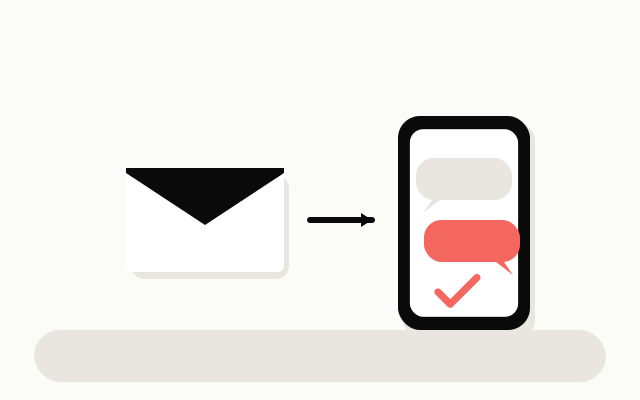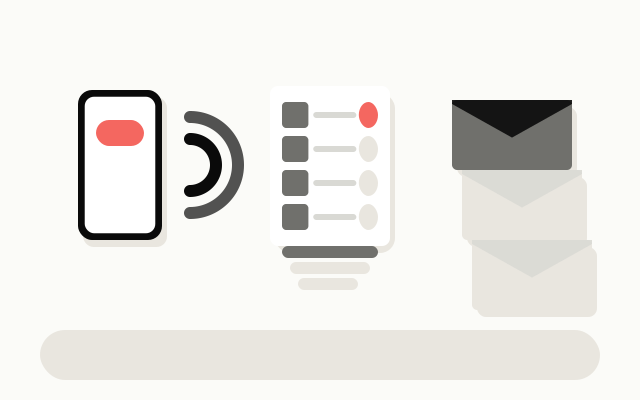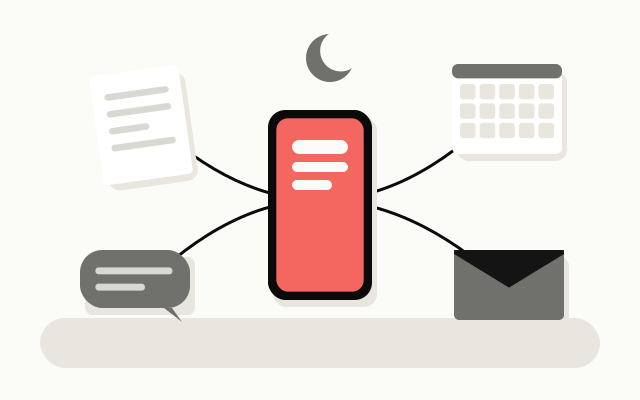
Focused interfaces for repeated operational work.
Karan Thete's product workshop · Perth
Repeated work.
Focused software.
Describe one repeated job. I will decide whether a conversation about no build, a smaller automation or scoped custom software is useful.
What Digital Rush AI does
I turn repeated business work into focused software and AI-assisted operating systems.
For teams running important work through spreadsheets, inboxes and human memory. The value is not “more AI.” It is a clearer path, fewer invisible handoffs and software shaped around the way the business actually runs.
Useful execution with human approvals and recovery paths.
Data, logic, interface and evidence designed as one path.
Need a website, not an operating system?
I also build fast, sharp websites for Perth small businesses. Prices on the page, mockup before you pay, live in about a week.
Request a workflow review.
Show me one repeated job and the operating context around it. I review whether a fit conversation is useful. Any diagnostic or build that follows has separate scope, terms and approval.
- 01You describe one job
- 02I review fit
- 03We choose the smallest sensible next step
ILLUSTRATIVE FIELD-SERVICE SCENARIO · NOT CLIENT DATA
The enquiry exists. The next move does not.
Email holds the request. A spreadsheet holds the history. The quote lives in a folder. The follow-up depends on somebody remembering.
Turn the scramble into one proposed route.
Capture the enquiry, qualify the job, assign an owner, stop for exceptions, schedule the next action and verify the outcome.
Build the tool around the route.
The interface, records, rules and agent actions are assembled around the mapped workflow. Not around a generic feature list.
Keep judgment with the operator.
Normal work can move. Unclear, sensitive or high-impact decisions stop in a visible review queue with context and a recovery path.
The end product is an operating surface.
One place to see what arrived, what the system decided, what needs a person and what has actually completed.
SIMULATION DATA
The workbench collection
Six stations.
One working system.
Scroll to move across the bench
Interactive diagnostic · Your numbers
Price the workaround
before pricing the build.
This is a transparent estimate of the labour currently touching one repeated workflow. It is not a DRA savings promise.
Workflow self-check
Where does the work
start losing context?
Choose the pattern closest to your business. The diagram shows what needs to become visible before software is worth discussing.
Enquiries arrive, but ownership is unclear
- One capture point
- A visible owner
- A dated next action
This is a conversation aid, not an automated assessment or a savings promise.
Flagship specimen · Lead Reactivation
Complex underneath.
Clear at the controls.
One confirmed public product, shown as a system rather than a wall of feature copy. The blueprint exposes the important operating boundaries without publishing credentials, endpoints or implementation secrets.
Reviewed input
Known records enter
CONCEPT NODEDecision layer
Rules · boundaries · stops
CONCEPT NODEHuman gate
Approval before action
CONCEPT NODEAgent path
Contextual conversation
CONCEPT NODEVerified outcome
Truth outside the message
CONCEPT NODEObservable state
What happened · what did not
CONCEPT NODEWhat the specimen proves
Complexity can live underneath. Control stays visible.
Lead Reactivation is the workshop's flagship founding pilot. This abstracted diagram illustrates how reviewed input, decision logic, an AI-assisted conversation path, human approval and outcome verification fit together. It is not client proof or a live-readiness claim. Implementation details and commercial terms are discussed only during a relevant project-fit conversation.
Inspect the confirmed public product, intended buyer and current boundaries.
From scrap to system.
The restored scroll timeline shows what each stage produces before the next stage earns the right to grow.
Observe
Observe
Bring the workaround, not the wishlist.
We start with the real sequence: what arrives, who touches it, where it waits and how people recover when it breaks.
inbox ─┐ spread ├──► person ──► person ──► ??? notes ─┘
Map
Map
Make the invisible decisions inspectable.
Inputs, rules, exceptions, ownership and the definition of done become a system map before implementation grows.
Build
Build
Build the smallest coherent operating path.
Interface, data and automation are assembled around the workflow, with a human at the gates that require judgment.
Verify
Verify
Test the edges, not only the happy path.
Failure states, recovery, observability and proof boundaries decide whether a polished screen has earned the right to operate.
[✓] expected path [✓] human override [✓] failure visible [ ] live proof: labelled
Karan Thete · PerthKaran Thete · Founder · Perth
One builder.
No mystery team.
Digital Rush AI is my product workshop. I stay close to the diagnosis, the build and the evidence. If something is only a concept, a rehearsal or a blocked product path, it stays labelled that way.
Direct founder contact: contact@digitalrushai.com. Digital Rush AI operates from Perth under ABN 21 729 039 895.
Fit before features
A useful build needs
a real operating owner.
Worth a review when…
- one job repeats often enough to matter;
- people can show the real current process;
- an owner can decide rules and exceptions;
- the desired outcome can be observed.
Usually not ready when…
- the request starts with a feature list only;
- no one owns the workflow or decisions;
- the team cannot access real operators;
- success depends on invented proof or unsupported outcome claims.
Questions before enquiry
Clear boundaries
before a call.
01What does a workflow review cost?+
The first step is a fit request, and it costs nothing. Any diagnostic or build that follows is quoted in writing with scope and terms before work begins.
02Do I need to replace the tools we already use?+
No assumption is made either way. The review starts with the current inboxes, spreadsheets, CRM, calendar and human handoffs. Replacement only makes sense when the operating friction justifies it.
03How long does a build take?+
There is no honest standard timeline for unlike workflows. Timing is discussed after the operating path, dependencies and verification boundary are understood.
04Who owns the software and data?+
Ownership, licences, hosting, access and data responsibilities must be written into the project proposal. They are not hidden behind a generic website promise.
05What happens when the system is unsure or fails?+
Approvals, exceptions, observability and recovery are treated as part of the system. They are not cleanup after the interface is finished.
06Is ongoing maintenance included?+
Support, monitoring, change requests and provider costs are defined separately for each engagement. Nothing ongoing is assumed until it is written and approved.
Primary commercial enquiry
Request a review
of one repeated job.
You do not need a software brief. Describe one repeated job in your own words and we will review it.
One useful next step
Bring me the process
you keep working around.
Start with the messy version. I will help determine whether it needs a focused tool, a smaller automation, or no build at all.